I Keep My Whole Life in Spec Files. My Agent Reads Them and Never Writes Them.
Every Sunday morning, an AI agent interviews me about my own life. It has read everything I have written down about the person I am trying to become, every goal I have set, every standard I claim to hold. It is very good at noticing where the last week did not match. This weekend it asked me why an intention I have now written three months running still has no evidence behind it. I did not enjoy the question. That is the entire reason it gets to ask it.
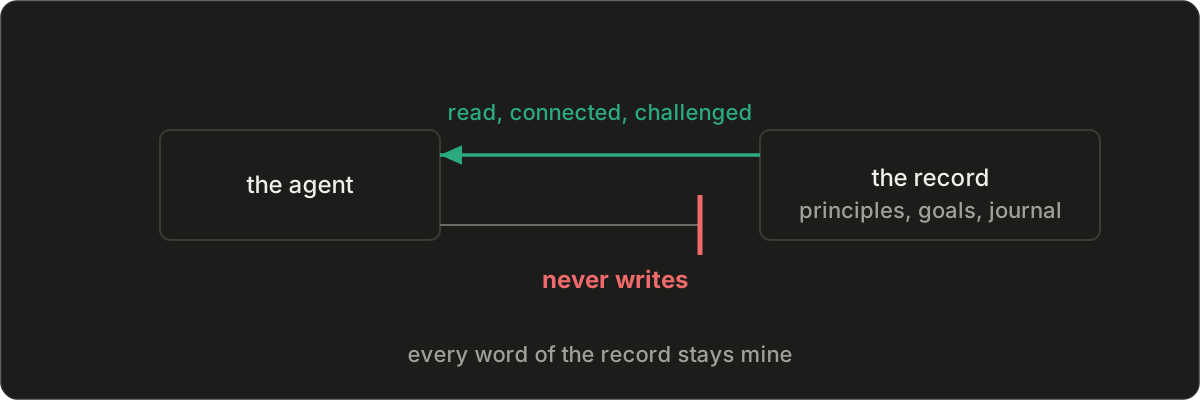
It can challenge me with my own record. It is not allowed to write a single word of that record itself.
For the last year I have been making one argument about working with AI: give an agent a curated structure to reason over, not a pile of documents. Context architecture beats documentation dumps. I built that idea into two production sites and a finance engine, where it meant scoped spec slices and bounded agent context. Then I pointed the same idea at the least organized system I own, which is my own life, and it behaved exactly the way it behaves on code.
A life as a spec'd system#
The principles I am trying to live by, the person I want to become, my goals, the areas I am responsible for, the projects I am driving: all of it lives as plain markdown in a git repository.
An agent reads those files at the start of a session the way a specialist agent reads a scoped spec before it touches code. Because the structure is there, it can see vertically. It can tell that this week's work connects up to a goal, that the goal serves a stated principle, that an area I claim to care about has gone quiet for a month. That vertical view is the part you cannot hold in your head on a Tuesday, and it is the part a structured agent is good at surfacing.
The one rule#
Here is the rule, and it is the part most "AI life coach" products get backwards. The agent organizes, connects, surfaces, and challenges. It never silently authors. I write my principles. I decide when a goal is met. I commit the journal entry in my own words.
The agent is allowed to interrogate me hard. It can point out that a principle I keep restating has no behavioral evidence. It can name the friction that has shown up three months in a row. What it cannot do is put words in my mouth and let them harden into the record, because the moment something other than me authors my life, the record stops being mine, and a record of your life that you did not write is worth nothing.
This is the same boundary I draw everywhere there are consequences. In my finance engine, the data I trust enough to composite into a grade is walled off from the data I only trust enough to watch, and a test keeps the crowd from ever moving the number. This is that same line, drawn in a different place. There it separates the inputs that may set a grade from the ones that may only sit beside it. Here it separates who may write the record from who may only question it. I use AI to pressure-test and accelerate, never to do the thinking I need to own. The agent makes the record sharper. It does not get to write it.
The part I am still bad at#
Nothing enforces this. A failing test screams at you; a life OS just sits there if you stop showing up. The system is only as good as the questions you let it ask and the cadence you keep, a couple of minutes most days, twenty minutes most weeks, a longer synthesis most months. And because there is no backend and no account, you carry your own backups and you decide which model provider sees a given session. Those are real tradeoffs of a system you own, and I would rather you know them going in than discover them later.
The rule itself is hardest exactly when it matters most. There was a session where the agent offered a cleaner version of a principle than the one I had written, sharper, truer-sounding, sitting right there for me to accept. I wanted to keep it. That is the moment the rule is for. I made myself rewrite it in my own clumsier words, because a principle I did not author is one I will not live by. The pull to let a fluent machine phrase your life better than you can is real, and giving in to it is how you end up with a beautiful record of someone who is not you.
I made my setup public#
The reason I trust this with the most private record I have is the design. The content of my life lives in a folder that is ignored by default, so the scaffold can be shared while the substance never leaves my machine. I run my own private instance, and it is in use rather than a demo: the foundation session is done, the principles and the journal are accumulating, the weekly cadence is holding. I am not going to show you any of it, and that is exactly the point. The method works without the method ever seeing your diary.
So I made the scaffold I use public. It is free, you fork it, you point your agent at one file that explains the contract, and you run a guided foundation session where the agent interviews you and you do the writing. It works with any capable agent; with Claude Code you also get the persona lenses and the cadence commands that make the weekly loop faster. It lives at specself.ai. Your content stays in your repo. I never see it. There is nothing to sign into.
The test#
This is about the line you draw any time you hand an agent a domain you care about. So here is the test I would give anyone pointing an agent at something that matters: name who is allowed to write the record. If the answer is the agent, the record has stopped being yours, no matter how good it sounds when you read it back. A code review, a design doc, a performance self-assessment, a journal: the agent can read all of it and question any of it, but the moment it holds the pen, you are no longer the author of your own account.
If you build software, the rest of the discipline is already yours: write it down, revise it forever, and never let the tool become the author. I just stopped making my own life the exception. The agent reads my spec files and asks the questions I would rather avoid. I am still the one who has to answer them in writing.
Related:
- Composite What You Trust, Watch What You Don't, the same boundary in my finance engine, drawn between the data allowed to set a grade and the data that only gets to sit beside it
- Context architecture beats documentation dumps, the method underneath all of this
- Spec-driven folder architecture, where the file structure itself started