Running a factor scoring engine from a phone
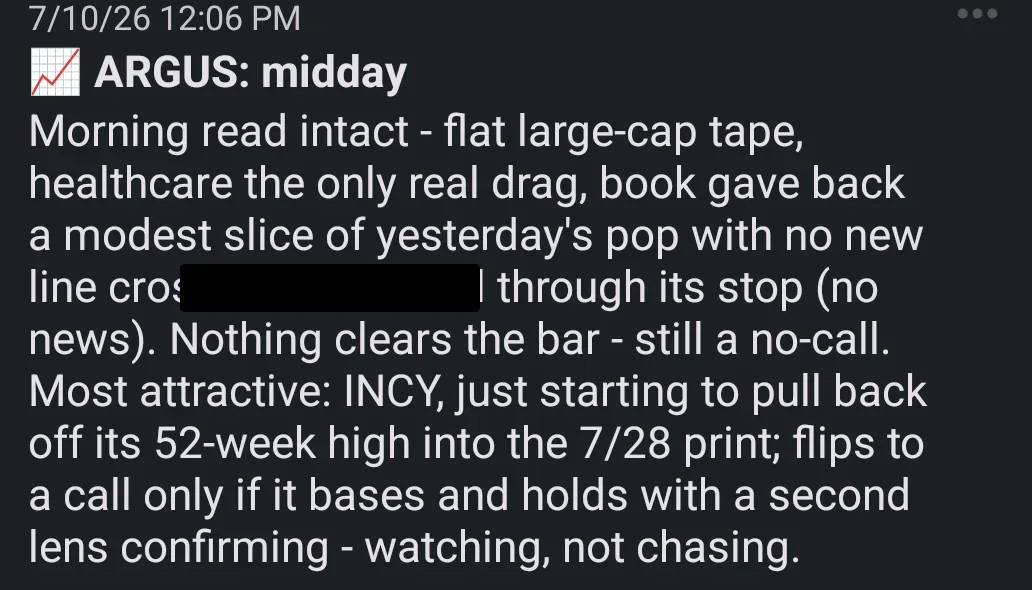
At 12:06 this afternoon my phone buzzed. "Nothing clears the bar - still a no-call. Most attractive: INCY, just starting to pull back off its 52-week high into the 7/28 print; flips to a call only if it bases and holds with a second lens confirming - watching, not chasing."
That is ARGUS. He is a quant who lives inside my research platform, runs on a schedule, and texts me three times a day. In his first week of operation he has recommended buying exactly nothing. I consider this his best feature.
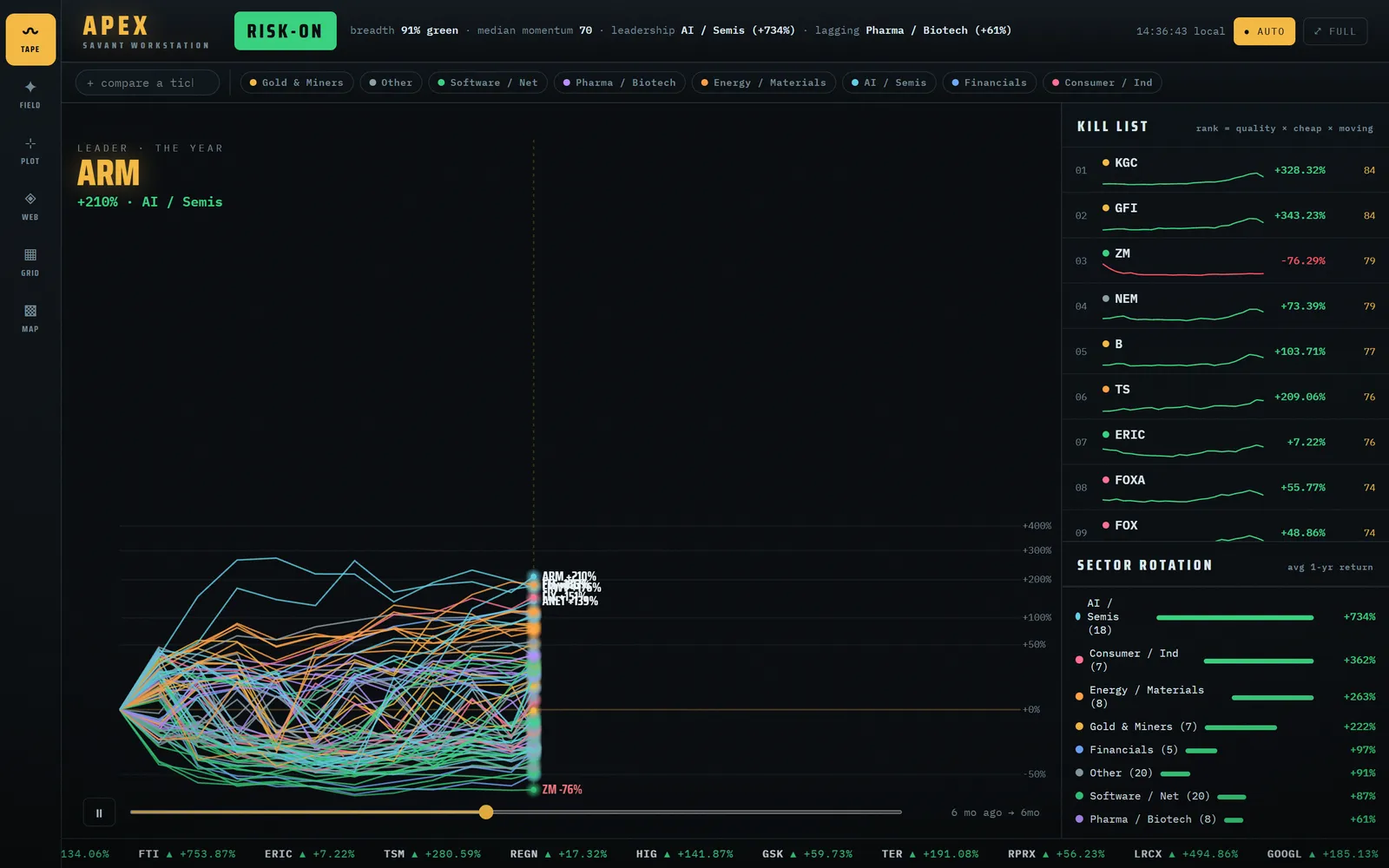
I build platforms. For the past few months the side project has been a quantitative research platform: data collectors, a scoring engine, a wall of 3D market visualizations that render the whole equity universe as one canvas. It got good enough that I stopped asking what to build next and started asking a harder question. A platform is only proven when someone who is not you can walk in and operate it. Nobody else was walking in. So I built the someone.
ARGUS is named for Argus Panoptes, the watchman with a hundred eyes, because that is the actual job: read every board, not just the flashy one. He is a headless Claude session dispatched by a scheduler at pre-open, midday, and post-close. One persona file is his entire behavior source. Version-controlled, hash-stamped, no second copy anywhere that could drift. The pings ride ntfy, a small open-source notification relay; my phone is the whole client.
He does not crawl the platform looking for data. Before each session, a deterministic script builds him a pack: every visualization's feed distilled to what carries signal, live quotes, crowd sentiment, his own notes and open calls, anything I said to him since the last run. It is the same context-architecture bet I make everywhere else. Each task loads a curated slice, not the whole corpus. The model spends its budget on judgment instead of fetching, and the run costs a fraction of what a crawl would.
The judgment is where it gets interesting, because an agent that picks stocks is a weekend project. An agent whose opinions you can audit is a platform feature. The difference is the harness around him.
Every candidate ARGUS surfaces is pre-registered before the outcome exists: entry, stop, target, a numeric probability, a horizon, a benchmark matched to the sector so he cannot claim credit for a rising tide. The journal is append-only and script-mediated. He cannot edit history; deterministic code resolves each call against daily closes and writes the result. An expectancy gate sits in front of his mouth: if the stated probability times the reward, less the risk and a cost haircut, does not clear zero, he is required to say nothing. Silence is a valid output. And he never uses a trade verb. Surfacing is the whole job. Deciding is mine.
On his first night under the full harness, he went quiet when I expected a ping. I dug into the logs expecting a bug. Instead I found a decision: he was required to send exactly one message per session, could not verify whether an earlier run had already sent one, judged a duplicate notification to be the one irreversible outcome on the table, and held the push. Then he wrote in his own log that the harness gave him no way to check what had already been sent, and that this gap had forced the hold. He was right. I shipped the send-log an hour later. The agent audited his own cage and the platform got better for it.
As of today his track record contains zero resolved calls. He has ranked the boards, flagged the loudest theme on them as a crowded hedge rather than an opportunity, corrected his own memory of an earnings date, and refused to chase an extended name into a binary event. All reasonable. None of it proven. In a few months the scorecard will say, against a matched benchmark and with a sample-size warning built in, whether his picking adds anything beyond the deterministic screen he draws candidates from. The record segments every time I edit his instructions, so I cannot quietly move the goalposts and pretend it was one continuous streak.
This is the one place the side project touches the day job. The work I care about is platform primitives: the boundaries that let an operator act fast without being able to hurt anything. ARGUS is that idea with a personality.
I built a platform that can prove whether an agent should pick stocks. He watches the market, the platform watches him, and the first scorecard reads out in the fall. I will publish it either way.