Building a Personal Finance Reviewer: What Survived the Rewrite
I run a personal portfolio reviewer. It takes a position export, scores every holding on a deterministic multi-factor model, flags allocation and risk breaches against hard thresholds, and produces a written review I can act on in a few minutes instead of a Saturday morning.
An earlier version of this post described that scoring model as a value-investing rubric. That was wrong, and not in a small way: the rubric graded one of the most dominant companies in the market a D+. I rebuilt the model. The story of how it was wrong, how I caught it, and what the rewrite cost is its own post, When the Spec Was Wrong, and I would rather link to it than edit the old claim out of existence.
The model got replaced. The architecture around it did not, and that is what made the rewrite survivable.
The one boundary that matters#
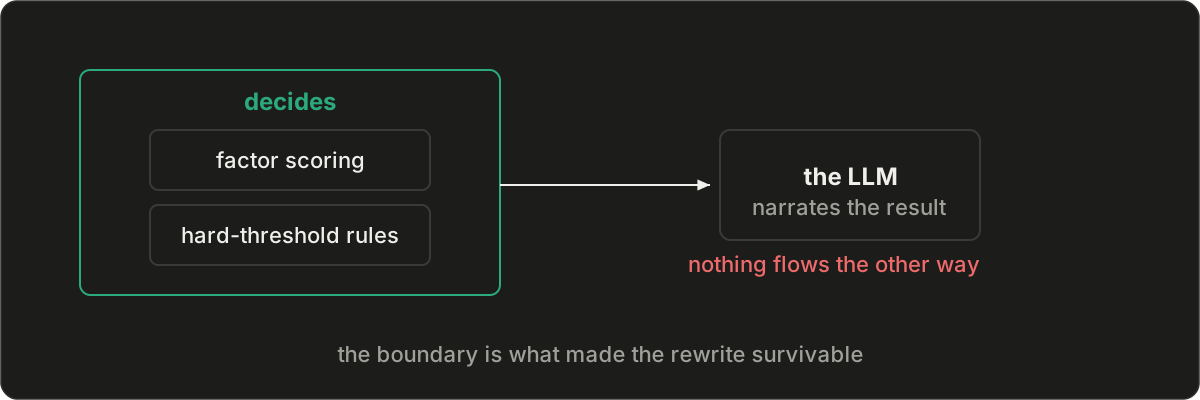
The system has three layers and a rule about which one is allowed to decide anything.
A deterministic scoring layer reads the positions and the market data and produces scores. Same inputs, same outputs, no model in the loop. A rules layer applies non-negotiable thresholds: concentration limits, sleeve caps, drift bounds. These are not advice; they fire or they do not. Only then does an LLM see the result, and its job is strictly to narrate: explain the scores, surface the breaches, write the review a careful investor would recognize as coherent. It does not compute a score. It does not overrule a threshold. It is told the numbers; it is never asked to derive them.
Everything load-bearing is deterministic and auditable; the model is a writing layer on top of facts it cannot change. When I had to throw out the scoring model, the blast radius stopped at the deterministic layer. The rules did not move. The narration did not move. The audit trail did not move. A rewrite that would have been frightening in a system where the AI decided the numbers was a contained change in a system where it only describes them.
Never let a missing number become a confident one#
The failure mode I care most about in a system with money attached is not a wrong opinion. It is a fabricated fact presented with the same confidence as a real one.
The concrete version: a price fetch fails for one holding. The lazy behavior is to fall back to zero, multiply it through, and emit a portfolio that looks complete and is quietly wrong, with a sell recommendation on a position that did not actually crater. The reviewer does not do that. A price fetch resolves to one of three states: a fresh value, a stale-but-real cached value with its age attached, or an explicit failure. A failed fetch is excluded from totals, weights, grades, and recommendations rather than silently coerced into a number. Stale-by-a-day, clearly labeled, is a far better signal to a human than a confident zero.
This principle is enforced on the price path and not yet everywhere. The sparse-fundamentals case, where a data provider returns nothing for a thinly covered instrument, is harder than the price case and is the edge I am still tightening. The principle is settled; the coverage is not yet complete.
The audit trail keeps the system honest over time#
Every review is written as an immutable record: the scored output, the recommendations, and hashes of the exact inputs and configuration that produced them. Reviews are not overwritten and not expired. If a recommendation looks wrong three months later, I can reconstruct precisely what data and what rules produced it.
This sounds like compliance theater for a one-user tool. A reviewer I cannot reconstruct is a reviewer I have to trust on feel, and the entire reason the reviewer exists is that I do not trust my own recency bias with real money. The immutability is the same instinct as the deterministic boundary: keep the parts with consequences inspectable, and keep the AI on the side of the system where being inspectable is not required.
What the rewrite actually taught me#
Because the scoring layer was deterministic, isolated, and specified separately from the code, replacing it was a bounded edit with a written decision record behind it. Because the AI was a narrator and not a judge, none of the rewrite touched it. The expensive version of this mistake, the one where the model is fused into the recommendations and the recommendations are fused into the prompt, is a system you cannot rewrite without rebuilding. I did not have that system, by deliberate choice, and that choice was worth more than any single call the original model got right.
If you are building anything that scores or grades where the output has consequences, the durable question is not which model. It is: when the model turns out to be wrong, and it will, how much of the system has to move with it? Keep that number small on purpose. Ship the deterministic version first, write down why, and assume the first model is a placeholder for the second one.