Goodbye Opus, Hello Fable
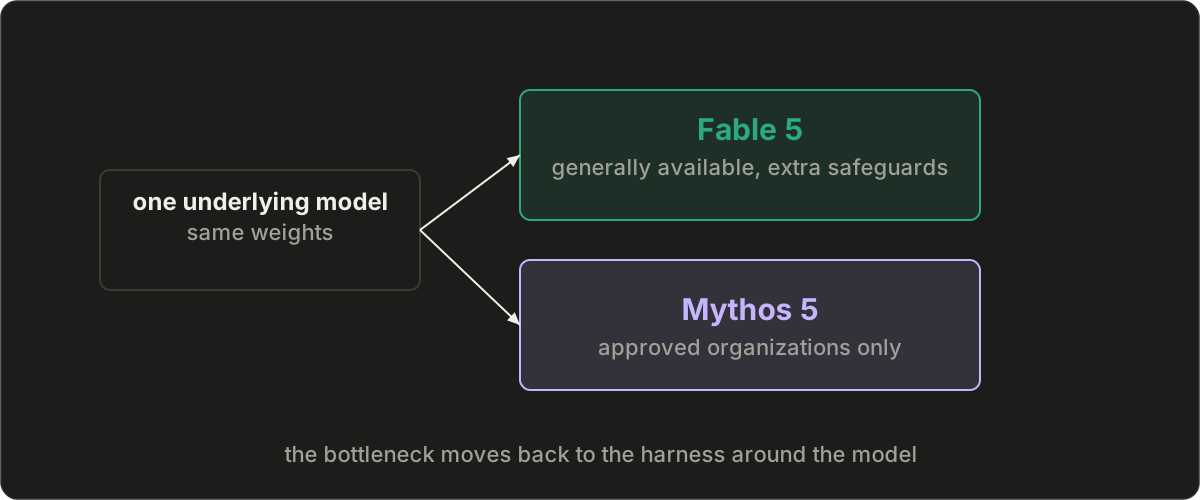
Anthropic shipped Claude Fable 5 and Mythos 5 today, and Opus is no longer the top of the lineup. Fable 5 and Mythos 5 are the same underlying model. The difference is safeguards: Fable 5 ships with them on and is generally available now, while Mythos 5 has the cybersecurity safeguards removed and is restricted to Project Glasswing partners and vetted researchers. Even the names admit it. Fable comes from the Latin fabula, "that which is told," the etymological sibling of the Greek mythos. Same root, same model, two names. Naming the safety boundary instead of pretending it doesn't exist is the right call.
For anyone running agents in production, this is the announcement that matters this year.
What changed#
Opus 4.x was already good enough that I delegated implementation authority to it across two product lines. Fable 5 moves the ceiling on what actually constrains agent platforms: long-horizon work.
The numbers worth caring about:
- Pricing: $10/M input, $50/M output. Less than half of Mythos Preview.
- Scale: Stripe ran a 50-million-line codebase migration in one day. Their manual estimate was two months.
- Benchmarks: state-of-the-art on essentially everything tested, including the top score among frontier models on Cognition's FrontierCode.
- Vision: it completed Pokémon FireRed from raw screenshots only. No scaffolding, no game-state API. That's the grounding test that matters for computer use.
- Context: long-horizon reasoning across millions of tokens, with persistent memory improving outputs over time.
- Research: first Claude model that generates scientific hypotheses consistently. Mythos 5 reportedly sped up protein design roughly 10x for one partner.
One partner quote sums up the shift: long-horizon problems that were "out of reach for earlier models" are now in reach. That tracks with what I've seen. Earlier models didn't fail on hard tasks, they failed on long ones. Drift, lost invariants, forgotten constraints around hour three. If Fable 5 fixes that, the bottleneck moves from the model back to the harness.
The safeguards, plainly. Fable 5 ships with three classifiers, and when one trips the response falls back to Opus 4.8:
- Cyber: blocks exploitation assistance and offensive tasks.
- Bio/chem: blocks dual-use research with pandemic or weapons potential.
- Distillation: blocks capability-extraction attempts.
They trigger in fewer than 5% of sessions, and there's a 30-day data retention requirement for safety monitoring (not training). For my workloads, agents writing TypeScript and Terraform, the practical impact rounds to zero. If you need the unguarded model for security research, Mythos 5 via Glasswing is the path. The rest of us don't get it, and that's fine.
So Opus doesn't fully retire. It's the fallback model behind the classifiers.
What I'm doing about it#
Caskey's Builder runs on Claude Code, so the swap is a config change, not a migration:
- Point Builder and Critic at
claude-fable-5once the subscription rollout reaches my tier (staged through June 23). - Re-run the dogfood specs and compare against the Opus baselines, particularly the multi-hour items that previously needed human re-anchoring.
- Re-evaluate
human_gateplacement in the backlog. Gates exist where the model historically lost the plot. If Fable 5 holds invariants over long horizons, some of those gates are now just latency.
Goodbye, Opus. You opened a lot of PRs. Fable, start telling.