Builder's Patience: The Knicks Are Champions Again
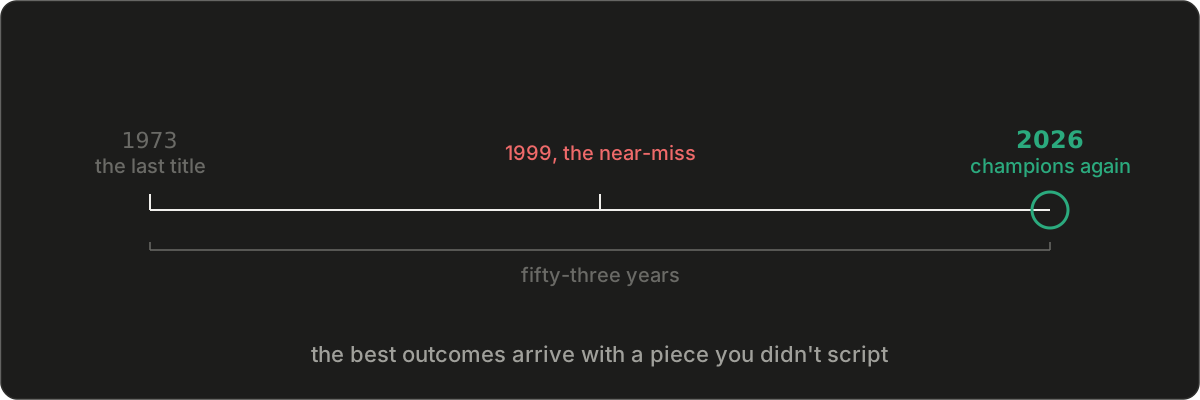
The New York Knicks are NBA champions. The last time that sentence was true, it was 1973. I have spent my whole life waiting for it, and I inherited the wait from my grandfather, who spent his.
This is a personal one. The thread, if you want a professional one, is the same instinct that runs through everything I build: patience, long horizons, and the humility to know the best outcomes still surprise you. But mostly this is about a basketball team I have loved through a lot of losing.
The ball on the shelf#
My grandfather spent his days watching the championship Knicks, the ones with Walt Frazier and Willis Reed. He passed down an image of that team, and more than that he passed down the way he talked about them, the way Clyde controlled a game and the night Reed limped out of the tunnel and the building came apart. He gave me a basketball signed by Willis Reed. It has sat on a shelf my entire life as a kind of promise: this team was great once, and it could be again, and you should stick around to see it.
He waited a long time for this one. I like to think he is watching tonight, keeping score the way he taught me to.
The lean years did the teaching#
I did not get the great Knicks. I got the ones that taught patience the hard way.
I watched Latrell Sprewell and the 1999 Knicks claw out of the eight seed all the way to the Finals, then run into the Spurs and lose. Close enough to ache. After that came the years I followed the team mostly through box scores, reading about the Stephon Marbury trade and the Eddy Curry trade and convincing myself each one was the turn. They were not. I wrote during Linsanity, when Jeremy Lin made February feel like a playoff run. I remember being genuinely thrilled the night Chris Duhon broke the franchise single-game assist record, which tells you exactly how lean things were. You learn to find the joy in the scraps when the meal never comes.
That is the part that doesn't fit on a highlight reel. Most of being a Knicks fan was not winning. It was showing up anyway.
The roster I drafted in my head#
Here is the confession. For years I built this team in NBA 2K, in GM mode, over and over, constructing dynasties out of a franchise that could not construct one in real life. And in those builds, two players were always on my board: OG Anunoby and Karl-Anthony Towns. OG for the pure athleticism, and because he played at Indiana, my favorite basketball school. KAT because he is from New Jersey, and because he might be the best three-point shooting big in the game while still doing the dirty work in the paint. A two-way wing and a skilled big who can shoot. I knew the shape of the team I wanted before the front office did.
When the real Knicks traded for OG and then for KAT, I felt something strange, like watching a spec get implemented by someone else. I had foreseen those pieces. What I did not foresee was the engine that actually drives this title: the Villanova core, Jalen Brunson and Josh Hart and Mikal Bridges, a group of guys who already knew how to win together before they got here. That part reality wrote better than I did.
And hats off to Leon Rose, because the real credit belongs to him. While I was running simulations, he was doing the actual thing. A quiet former agent took over a franchise that had been a punchline and built this deliberately, one move at a time, Brunson and then Hart and then OG and then Bridges and then KAT, without ever mortgaging the future for a splash. I admire builders, and he is the builder here. It was something to watch an idea I had only ever run in a simulation get implemented for real, and then extended past anything I drew up, all the way to a title.
Which is the whole lesson, and the one place this touches the day job. I build systems for a living, long-horizon ones, and the way you do it is patient and deliberate, no shortcuts, the pieces assembled over years. You spec what you can foresee. OG and KAT were the parts I could see coming. But the best outcomes always arrive with something you did not script, and the discipline is to leave room for it instead of forcing your old plan over the better one in front of you. I had a plan for thirty years. The version that won was partly mine and partly a gift.
Goodbye to the waiting#
So the wait is over. Fifty-three years, answered. Brunson and Hart and Bridges power it, OG and KAT anchor it, and a franchise that spent my entire life as a lesson in patience finally paid the patience back.
I keep looking at the Willis Reed ball on the shelf. The promise on it came due. My grandfather handed me a team and a way of waiting for it, and tonight both of those finally make sense. Patience is not passive. It is the longest game there is, and the Knicks just won it.
Goodbye to the waiting. Hello, champions.
Keep reading
A Summer of Sharpening
The third post in the SDD numbers series is not about velocity. Since June the platform's effort moved into four quiet systems: an externalized memory, a statistical screen that refuses to flatter me, a point-in-time data floor, and a product designed entirely on paper. What that did to the shape of a productive week.
Seven articles to a platform that improves itself
The full path to an agent platform that edits its own instructions is already published, scattered across seven articles that never mention each other. I run that architecture as one person: supervisor and worker tiers, verification guards, external memory, a work queue, and a weekly pass that sweeps corrections back into the instruction files. Here is the platform, layer by layer, with the article that teaches each layer.
Autopsy: the 5/10 strategy that never lost
A viral post claimed a simple 5/10 moving-average strategy that has not lost in eight years. I codified the most charitable readings of the claim, ran each one over SPY with costs, and checked the claim against its own success metric. It fails under every interpretation, and the receipts are hashed.
Tested, not trusted: the order block
The order block is trading social media's favorite glossary card. I wrote the definition down as code, ran it across 30 large-cap names and five years of daily bars, and measured what the retest entry actually earns net of costs. The verdict, the exact rule, and the artifact hash are all here.
How this site is organized
The navigation on caskeycoding.com is a build artifact: one public content graph, several switchable views projected from it, and CI checks that keep the graph and the routes from drifting apart.
The Pipeline That Ate Itself
A Windows Task Scheduler default fed my Claude Code memory pipeline its own transcripts for nine days: 21,264 junk sessions, 38 GB of exhaust, and an 18,428-session backlog that was really 1,924. The durable fix: postconditions that outrank green dashboards.
Follow the work
New tools and writing as they ship — pick a channel.