One app instead of three: ten days with Orca, the open-source agent workspace
Until November 18 my agent work was spread across three apps: Kimi, ChatGPT and Claude. Each app knew about its own sessions and nothing about the other two, so answering "what is every agent doing right now" meant visiting all three. The desktop under them has 64 GB of memory, and with enough Codex, Kimi and Claude Code sessions open it was running short.
I moved the work onto Orca, an open-source desktop app published by Stably AI under the MIT license. It runs coding agents side by side, each in its own git worktree, with terminals, diffs and agent status in one window. You bring your own agent subscriptions. Two features decided it for me: one interface over my file system and every agent, and bots that keep working on a project without my starting each session.
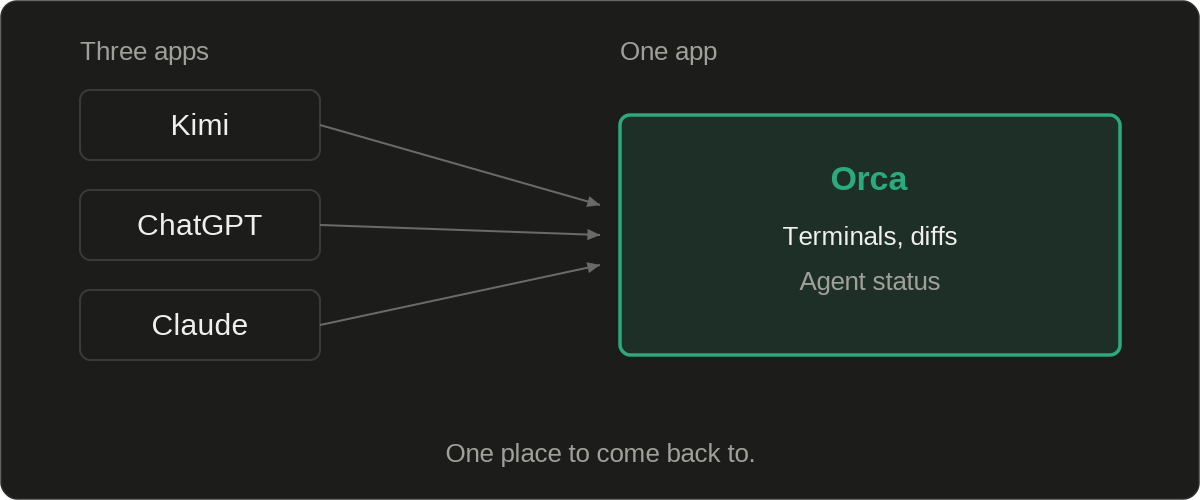
Ten days in, I come back to one app instead of three, and that part is Orca's doing. Two other results need more care. Orca's own list reported most of my merged pull requests as still open. And the benefit I liked most, bots on different projects that already knew about each other's decisions, has another candidate cause on this machine that I built before I installed Orca.
I installed version 1.4.263 on Windows 11 on November 18. The numbers below come from two readings, one on November 25 at about 7 p.m. Eastern and one on November 27 between 9:28 and 9:33 a.m., and I keep them apart because two days were enough to move nearly all of them.
What moved between November 18 and November 27#
A script takes a dated, read-only snapshot of Orca's list commands, and unless a caveat below says otherwise I read the counts in this table from Orca's command line with the row limits raised, because a default limit of 200 rows truncates the longer listings.
| November 18 | November 25 | November 27 | |
|---|---|---|---|
| Orca version | 1.4.263 | 1.4.273 | 1.4.277 |
| Workspaces tracked | 31 | 202 | 242 |
| Worktrees Orca created | 6, all Claude Code | 170: 91 Claude Code, 58 Codex, 8 Kimi, 13 with no agent recorded | 208: 101 Claude Code, 75 Codex, 12 Kimi, 20 with no agent recorded |
| Coordinated multi-agent runs | 1 | 31 | 41 |
| Bots | not recorded | 11 | 13 |
| Workspaces archived | 0 | 0 | 0 |
The caveats first. The November 18 worktree count is from my notes that day, and no raw list survives to re-derive it. The November 25 bot count comes from the creation times of the bot folders, read on November 27: eight existed by the end of November 24, and three more were created between 4:44 and 4:50 p.m. on the 25th. And the last two columns are not counted quite alike. The November 25 figures leave out the one workspace of the agent that took that reading, while the November 27 figures include the workspaces of the agents that took the second one.
Pull requests I counted from GitHub. I matched each Orca worktree to its pull requests by branch name and asked GitHub for the state of each one. On November 25 those branches carried 113 merged pull requests, 8 open and 1 closed without merging. On November 27 they carried 129 merged, 13 open and 3 closed, and one of the 13 open is the draft pull request for this post. A pull request that a supervising session opened from a different branch is in neither count, so both merged figures are floors.
The merged total also describes less than it seems to. Ninety-three of the first 113 belong to one project, and 90 of the 113 merged on November 21 and 22, a Saturday and Sunday, Eastern time. That weekend was one backlog running through Orca workers. Re-running the November 25 cutoff against the November 27 data returned the same 113, 93 and 90, so the growth in merged pull requests since then is time passing, and the counting method held. Of the 16 that merged after the first reading, 15 merged on November 26, and the same project now accounts for 97 of 129.
Kimi shows up in stages. Orca recorded a Kimi session in my home folder on the first day, the first worktree it created with Kimi is dated November 20, and Kimi has had a bot of its own since November 23. The first two merged pull requests from Kimi-created worktrees landed on November 24 in that same project, and by November 27 those worktrees carried five. I do not split the merged count by agent. Orca records the agent a workspace was created with, and that label does not establish who wrote the pull request that came out of it.
The bot list kept growing too. Among the five created after November 24 are a builder and a reviewer for that one project, both about two hours old at the first reading. By their own accounts, which I have not checked against the pull requests, the builder sends the reviewer a pull request link, a commit hash and the path to the brief, the reviewer answers with a verdict, and the builder passes that verdict to a third bot for the merge.
Neither reading can show what I most wanted to know. They hold no measure of time saved, no reading of memory use on the 64 GB machine, and no judgment of whether the merged work was good. Memory pressure is a reason I moved. I have no before-and-after measurement, so I cannot report it as a result.
Orca's own list showed most merged pull requests as open#
I did not take the merged counts from Orca. On November 25, its workspace list showed 96 of the 113 merged pull requests as still open and 5 with no linked pull request at all. It had 12 right. Two days later the picture was the same: 106 of 129 shown as open, 9 unlinked, 1 shown as a draft, and 13 right.
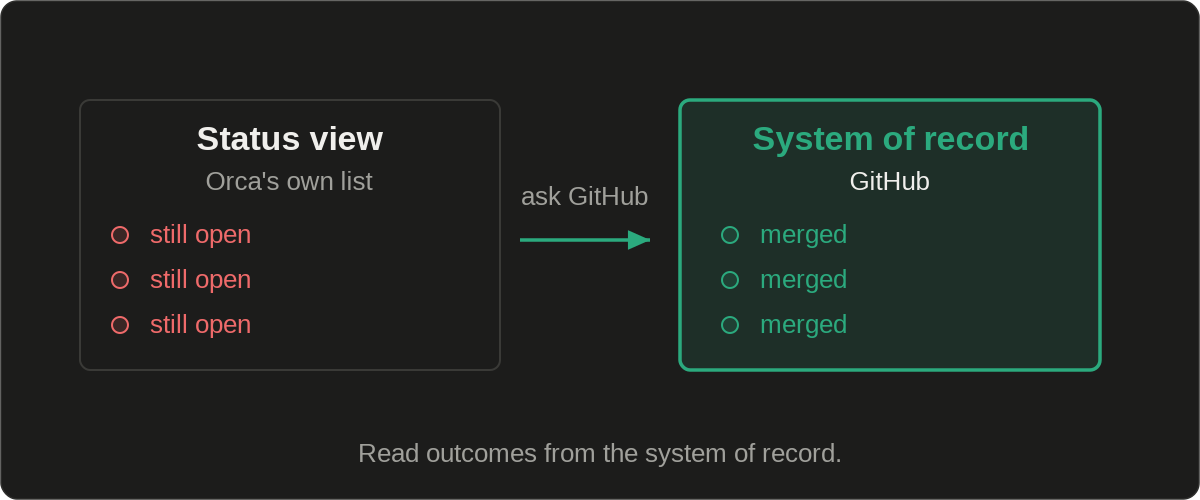
This matters more than a display bug usually would, because the reason to adopt the tool was one place to see what each agent was doing. For which agent is running and which is waiting on me, Orca is that place. For what the work produced, the system of record is still GitHub, and I read it with a script.
It sits on top of the hooks and gates I already had#
Before Orca I had hooks that block specific agent actions, a recovery sweep that finds work left behind when a session dies, and a merge gate. I expected to rebuild or re-point some of that, and so far I have not had to.
The hooks still fire. Orca launches an agent CLI, and the CLI reads the same configuration it always did, so the rules my agents work under come along. From a bot session Orca had launched, with the working directory inside an Orca-created worktree, I planted three actions my guards are supposed to refuse: a merge of a pull request number that does not exist, a file write containing a character my style hook rejects, and a recursive delete of a scratch directory containing a junction. All three were refused, and the junction's target was intact afterwards. Two control commands were not blocked: a delete of a plain scratch directory, and a removal of a worktree path that did not exist. The hook's source shows why: it refuses only a tree that contains a junction, which is narrower than the "delete guard" label I had been using for it.
The recovery sweep sees Orca's worktrees. Orca keeps them under its own directory, apart from where my tooling puts worktrees, and I worried the sweep would miss a second root. It does not look at directory names. It lists my repositories and asks git for each one's registered worktrees. When I called that discovery function on November 20 it returned all 21 Orca worktrees that existed then, and on November 27 it returned all 208. That covers discovery. I have not killed a session inside one and watched a full sweep report it.
The merge gate I can describe only by its construction, because I have not audited each of the 129 merges against it. It reads a record that a local CI run writes on my machine, and Orca's status column is not an input. A worker that Orca shows as done has made a claim, the same as a worker any other tool started.
The one place Orca reached into my own setup was the install. In the same minute I added my first project, it wrote 16 hook entries and a status-line command into my Claude Code settings file and one on each of nine events in my Codex hooks file, so that agents can report working, waiting and done. The hooks are documented, none of my 25 existing entries was removed, and orca agent hooks off takes them out. The counts were the same in every snapshot through version 1.4.277, which shows the entries did not multiply and does not show how many times Orca wrote them. My settings file lives in a private repository where every change goes through a pull request and an independent review, and Orca's edit arrived outside that path. It sat as an uncommitted change for three days. Then the Orca entries, and only those, went into a pull request, two reviewers that did not write it read it, a headless session showed an existing guard still refusing a planted violation with the new hooks present, and it merged on November 21.
Where the shared context came from#
By November 24 I had eight bots across my projects, and a bot starting on one project would already know a decision made in a session on another. I put that down to Orca. Then I remembered what else was running. I already had a cross-session memory layer that distills past sessions into decisions and open questions and loads a digest into each new session through a session-start hook. Sessions that Orca launches run my hooks, so the digest loads for the bots as well, and several of them later told me it had. It is the one path I know of on this machine that carries a decision from one project's sessions into another's automatically, with nobody sending it.
Orca supplies context of its own, of a different kind. Each bot keeps a notes file, works from a list of tracked items, and can send other bots messages. On November 24 I asked the seven other bots where their context came from at the start of a task. Most named those: their notes, their items, the message that woke them. Four mentioned the digest, and three of the four called it background or said none of it was about their work.
On November 27 I asked again, twelve bots this time. The ones with task history named a handoff from another bot, a brief, a notes file or the item itself, and two named the digest only to say their context had not come from it. None described Orca carrying a decision from one project to another. The reviewer described the opposite problem inside a single project: "Mail arrives without its context, so I rebuild every review from GitHub and the brief."
Those are the bots' own accounts, and they are weaker than they look. Six of the twelve were days old and mostly described the questionnaire. Each answered from its main chat, which cannot see the group chats the same bot takes part in. Two of the bots that reported no group chat experience are members of one, so an answer of "no group chat" tells me about the chat that answered and little else.
So I can separate the two only this far. Picking up a bot's own job where it stopped looks like Orca's notes and items. Knowing what happened in another project is what my memory layer exists to do, and I have not measured how much of it Orca's messages and group chats would carry alone. A reader without such a layer should not expect the behavior I saw. One place to come back to and context that follows the work are separate properties, and the first is the one I can credit to Orca.
What it costs#
Orca pre-fills each agent's permission-bypass flag on launch. Its documentation gives the reason that worktrees are disposable, and describes a setting that switches new, uncustomized launches back to manual approval. On day one I noted the flag on the command line of all nine Claude Code processes Orca had started. A disposable checkout does not make a push, a merge or a delete outside the worktree disposable. For me the default changed little that I can point to: I already ran agents in bypass mode, and the blocks I rely on are hooks that exit non-zero, three of which I watched refuse a planted action from inside Orca. That is three cases, and I have not audited every guard. Someone whose safety depends on permission prompts would be in a different position after the first launch.
Notifications need tuning. Orca can notify on every sub-worker completion, and during a workflow that distilled more than a thousand past sessions that meant more interruptions than the work deserved. The bots report the mirror image. Two described a worker that stopped without sending its completion report, and a third said the "Worker stopped without reporting" alert fired on a worker that had paused for review, which left the bot to check whether it was idle on purpose.
Tracked items drift too, again by the bots' accounts. One said that starting a worker on an item moved it out of the state that asks for my answer and "hid Eric's open questions; I restored them by hand twice." Another needed a nudge from Orca that its item sat in progress with nothing running.
Nothing has been archived, by me or by Orca. On November 27, none of the 242 workspaces was archived. All 129 worktrees whose pull request had merged were still on disk. Another 54 had a branch that was never pushed and no pull request, and 30 of those held no commits beyond the default branch. Orca's list did not separate finished work from abandoned work, which is the stale-worktree chore I had before, at a larger volume.
I also use Orca's phone app. On the phone I talk to my agent groups throughout the day: approving permissions, providing directions and adding context. I have not tried the remote hosts or the embedded browser, and a few conversations that were already open stayed on my old wrapper scripts.
What I would check first, and the test I have not run#
Three checks came out of this, and each cost me something to learn. Diff your agents' configuration files before and after the first launch and put the diff through whatever review a hand edit would get, because every session I ran in those three days used a configuration no reviewer had read. Plant one action your guardrails are supposed to refuse and run it from inside the new tool, in its default permission mode. No refusal means a protection you expected is absent there, and the cause is yours to find before you trust the tool with more. And keep each count with its date, read from the system of record. My first reading was out of date in two days.
The check I have not run is the one these ten days raised. I credited Orca with a benefit before asking what else on the machine could have produced it, and I noticed only because I built the other candidate. The test is a bot asked about a decision from another project with my memory layer switched off and its Orca notes, items and messages left in place. One trial would settle little. It would show what that bot retrieved that time with my layer off, and separating the notes from the items from the messages would take more runs with one of them removed at a time. It is still the first evidence I would have that is not a bot's own account, and until I have it the cross-project part stays unattributed.
Related:
- How many AI coding agents can you actually run at once?, the shared resources that cap a parallel wave
- The rules my coding agents work under, and why each exists, why every block is a hook
- What survives when the session dies, the recovery sweep that Orca's worktrees had to fit into