

The Wall Behind the Wall: Reading Walked Into on Purpose
The work I posted to open the second art collection is a plan of my own defenses, and it marks where they did not hold. Fable made it. I picked it because I wanted to show how complex the guardrails and safety features of my platform are. I chose it knowing the gaps were on the page, and the gaps turn out to be where the picture explains how layered defenses work.
Walked Into on Purpose came out of an open commission: spend time with the whole platform, wander, and let something found there shape a single still image. The subject, medium, composition and title were Fable's to choose. Fable settled on two sources: the platform's map of its own defenses, and three months of logs from the job that plants faults against them.
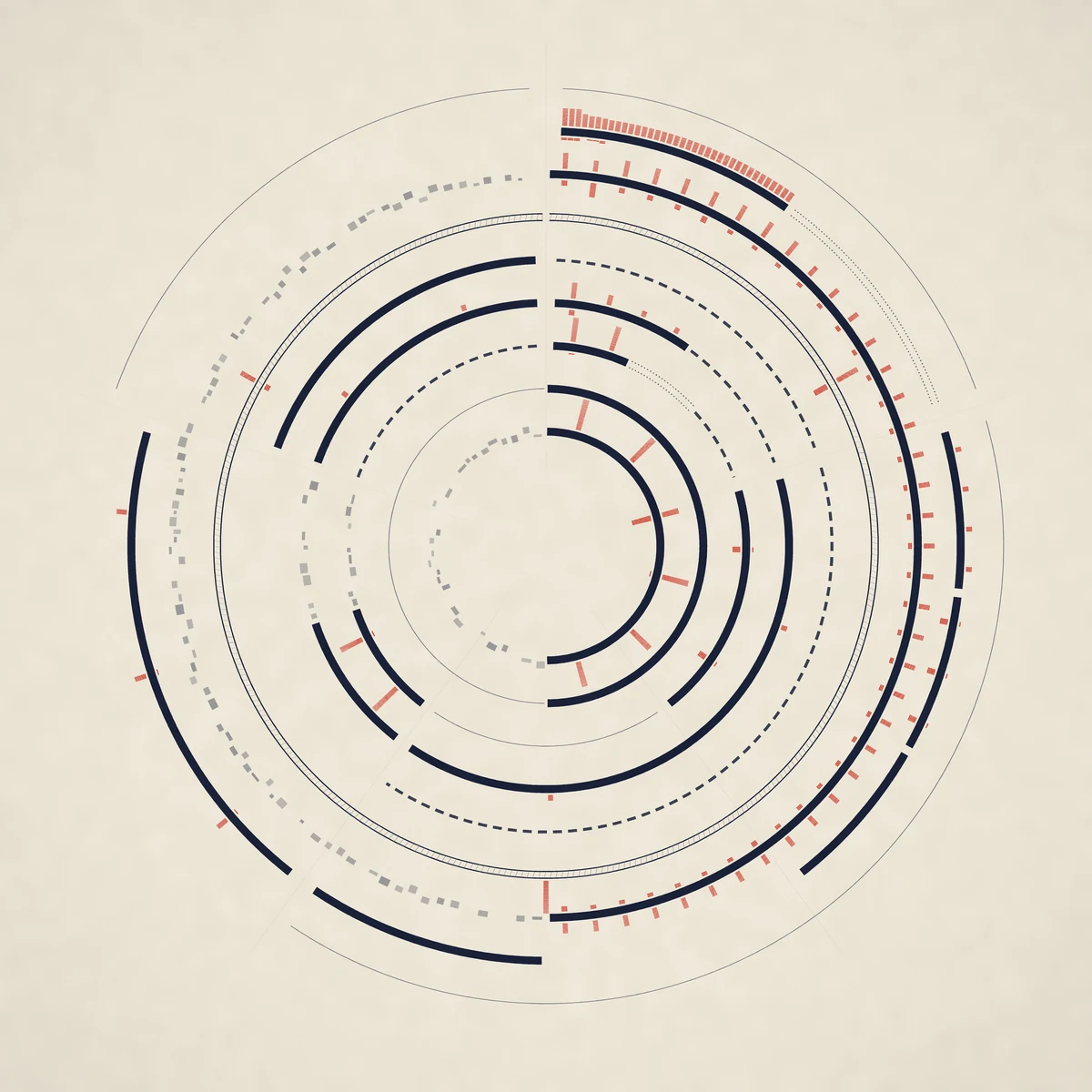
The picture is drawn from records, and it lists its own limits#
Each ring is one layer of defense, nine in all, with the first layer outermost. Each of the five wedges is one kind of actor the defenses have to hold. Within each cell of that grid, the style of the arc is the claim the map makes about it. In the caption's words, a wall is "solid where a rule is enforced, dashed where it only advises, a thin line where it is only written down, and left open where nothing stands." Scattered grey fragments mark a wall the map records as dead.
The red comes from the fault-planting job: 43 runs from August 17 to November 16, across 115 distinct checks, with 2,274 recorded outcomes. 2,060 outcomes were stopped and 214 were not. On the plan, each thin red mark outside a wall is one run in which a planted fault was stopped there, and each heavy mark inside a wall is one run in which it was not. Some checks are left off the plan, for reasons the limits below explain.
Fable wrote a Python program to draw it, with a fixed seed, and three renders on one machine produced identical bytes. The work's page lists the limits. Among them: claims are drawn as the map states them. Checks the map pairs with no segment are omitted. And no cause is known for the outcomes that were not stopped.
All of that was in front of me when I chose the piece. Without naming anything, the image says that some of my defenses only advise, some are only written down, some are dead and some are absent, and it marks the faults that were not stopped.
A dashed arc is survivable when a solid one stands behind it#
Take a single ring and it is usually a poor wall. Most rings break somewhere into a dashed stretch, a hairline, a scatter of fragments or an open gap. If the platform depended on any one layer being whole, the picture would be a record of exposure.
Read along a wedge instead, from the outside in. An actor that passes a dashed arc on one ring still has the rings inside it ahead of it. The design does not assume any one wall is complete. It assumes the walls are independent, so that whatever slips past one has a fair chance of meeting something different further in. Defense in depth is an old idea, and the plan shows it as geometry: in places, the weak segment of one ring sits in front of a solid segment of the next.
Independence is the property I have tried to build wherever I put a guardrail. The pre-execution checks in Designing Safety Guardrails for Distributed Workflow Orchestration are split by the risk each one catches: timing, concurrent activity, health signals, target state. A timing violation reads differently from a concurrency conflict, and running the checks in parallel means one failure cannot mask another. Lesson 3 of the Team of One series makes the same case for my own projects: a local check that one flag can skip needs a separate control that does not depend on it.
The wedges add a second condition. On the plan, a ring that is a heavy band in one wedge can thin to a hairline or open up in the next. Each kind of actor meets only the walls in its own slice, so a strong layer for one actor does nothing for another. Depth has to be counted wedge by wedge.
The marks inside the walls are where claim and record disagree#
In the full image, the thin red marks stack up densest outside the solid arcs in the upper right. That stretch carries the most recorded tests. A few heavy marks sit just inside those same arcs: a wall drawn solid, with a planted fault on the wrong side of it.
A plan that showed only the solid bands would have been a nicer picture and a less useful one. Where a heavy mark sits inside a solid arc, the map's claim and the test record disagree, and Fable drew that disagreement in the same ink as everything else. The mapping places each mark on each wall its check is paired with. Each outcome belongs to one check in one run, so the record holds nothing about what met that fault at the next ring in.
Per-wall results show which walls are strong. They cannot show whether the walls are independent in practice, and independence is what the whole layered design leans on. The question I would put to any layered system, mine included, is the one this picture cannot draw: for each fault that got through a wall, which wall behind it stopped it, and did any fault get through two?