Welcome: Building Platforms for Scale
The sharpest lesson of my career came during a deployment when a batch of misaimed alerts paged an entire support queue at once: when the automation is large, a small mistake does not stay small. I have spent most of my career on one problem in different shapes, keeping a large system accurate about its own health without a person having to remember to check. Monitoring, and the automation around it.
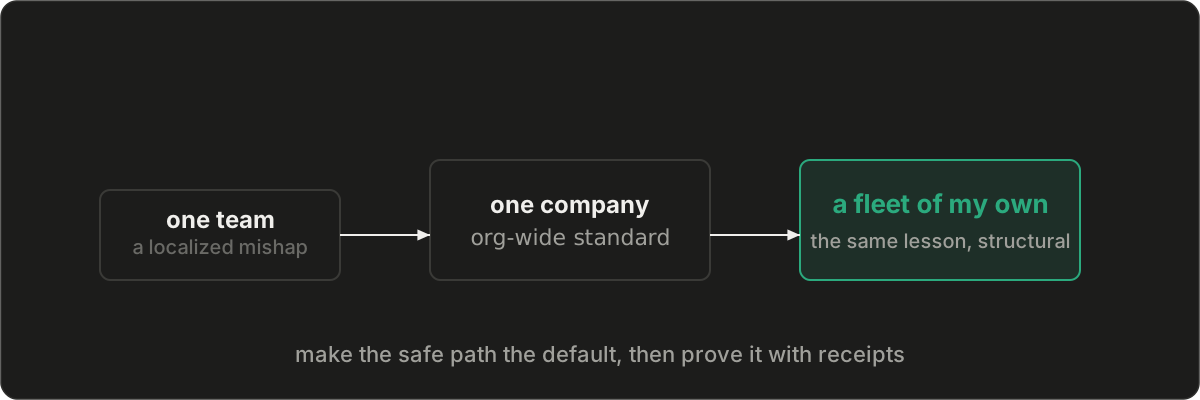
One team's standard, a company's blast radius#
At Prudential I owned the enterprise monitoring platform and set the standard for how infrastructure got watched across the company. I chose the hardware it ran on and led the migration off the legacy systems onto that standard. The lesson that stuck was about blast radius. When one team's decision sets monitoring for a whole company, a good call protects critical services and a bad one exposes them, and you often do not find out which you made until something breaks.
Coverage that every team gets by default#
The next version of the problem was the same one an order of magnitude bigger. Infrastructure at Amazon came and went constantly, so the monitoring had to find new hosts and services on its own, attach the right alarms as they appeared, and let go as they disappeared. Writing the shared standards, alert policies, and deployment playbooks turned that from a chore every team repeated into something they got by default. I wrote about that work in more detail in a case study on fleet monitoring.
The payoff was that a team could ship a service without first becoming a monitoring expert, and still trust that if the service got sick, someone would know.
The mishap#
Not every deploy went cleanly. One afternoon we rolled monitors across a large slice of the environment and pointed every one of their alerts at a single support queue. For a short stretch that queue took an alarm from every affected host at once, until we aimed the flood back at ourselves and rolled the change back. It taught me the rule I still work by, in one sentence: when the automation is large, a small mistake does not stay small. It arrives everywhere at the same time.
What I write about here#
That is the throughline, and it still runs through everything on this site. I build systems where the safe behavior is the structural default rather than a rule someone has to remember, and I write about how that goes, including the parts that fail.
These days the systems are my own. A finance engine that grades stocks on rules I can inspect, a playground of interactive market visualizations, and a running account of what it is like to build and ship software this way, with an AI agent doing the typing. The domain moved from enterprise infrastructure to a small fleet of my own products. The question did not: how do you build a system you can trust, and how do you prove that rather than hope it?
What is different now is that I can show the receipts: the code, the dated track record, the run where it broke, so you can check that the safe path held instead of taking my word. If you have ever watched a one-line mistake page an entire fleet, we will get along.
Eric Caskey