Does the order block pattern predict price? A backtest of the claim
A glossary card defining the order block collected thirteen thousand likes in the inspiration batch I keep for this series. It had clean typography, a tidy candle diagram, and no evidence of any kind. That is the genre: definitional confidence, zero base rates. This series republishes the format with the one column the genre never ships. Here is the definition, and here is what it tested at.
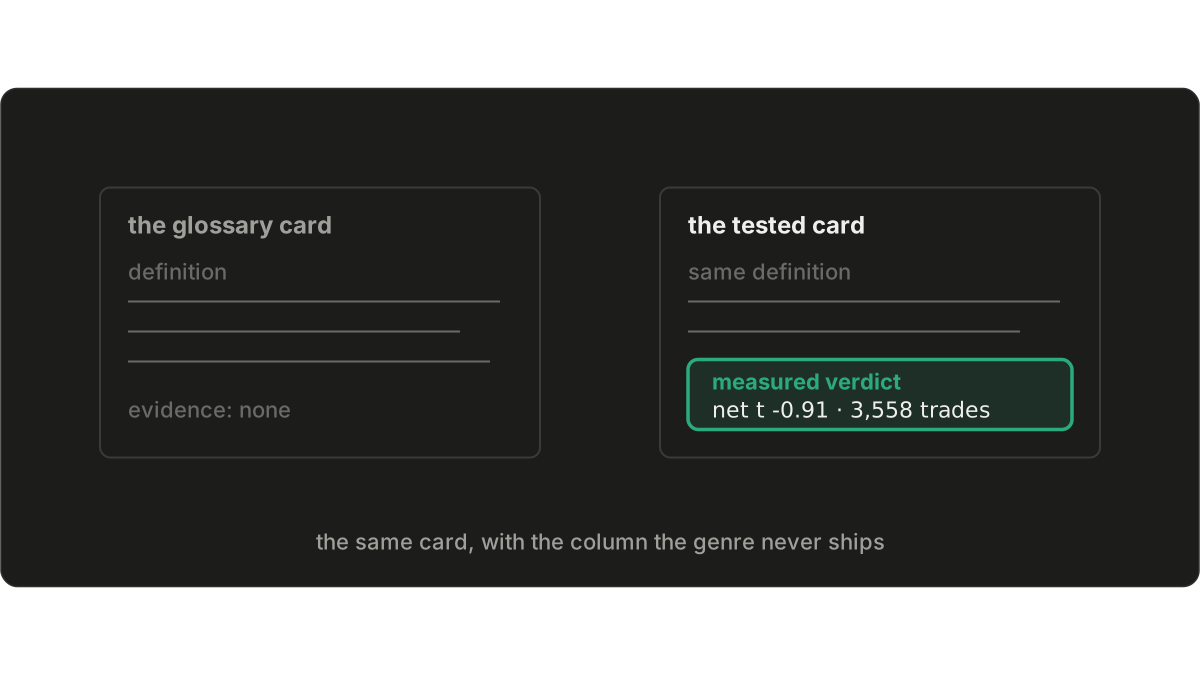
The definition, made executable#
Prose definitions of the order block do not commit to anything a computer can check, so the first step was writing one down that does. The last opposing candle before a displacement move, where displacement is required and measured against the recent swing structure with a 5-bar lookback. The tradeable rule: enter in the block's direction at the close of the first bar whose range retests the zone, searching from two bars after the block so the displacement is fully observable, and exit after a fixed N days. No discretion anywhere. Every parameter is in the artifact.
The test#
Thirty large-cap US names, daily bars from 2021-07-23 through 2026-07-21, 37,560 pooled periods. Horizons of 3, 5, and 10 days, a small declared sweep over the swing lookback, and 10 basis points of cost per side. Nine variants total, declared up front, so the overfitting check has honest inputs.
The verdict#
| Metric (default variant, 5-day exit) | Value |
|---|---|
| Trades | 3,558 |
| Hit rate | 48.2% |
| Annualized Sharpe, net | -0.07 |
| Net t-statistic | -0.91 |
| Probability of backtest overfitting (9 variants) | 0.57 |
The strict, displacement-required order block retest earned nothing net of costs in this window. The t-statistic is not just small, it is slightly negative. And the PBO of 0.57 says the best-looking variant in the sweep is more likely than not an artifact of picking the best-looking variant. If the edge is real, it is not in the daily-bar retest rule the glossary cards describe.
The boundaries: one five-year window, one universe of liquid large-caps, daily bars, fixed exits. A definition this popular deserves retests on other intervals and universes, and the harness is built to run them. What it does not deserve is to be taught as an edge before anyone has measured it.
The number is pinned to its run. Detector v1.0.0 at git f9f4f50, parameter
hash a702f152...d99d3, artifact order_block.json from the evaluation run
of 2026-07-22. The recorded config reproduces this table, and the hash is
what keeps me honest about which config that was.
This is historical analysis of a public trading concept, not investment advice, and not a forward claim about any market. Nothing here is a recommendation to trade anything.
Questions this post answers
- What is an order block?
- In the smart-money-concepts vocabulary, an order block is the last opposing candle before a strong displacement move, treated as a zone where institutions supposedly left unfilled orders. The tradeable version: when price later retests that zone, enter in the direction of the original move.
- Does the order block retest entry work?
- Not in this test. Across 30 large-cap US names, 2021 to 2026, daily bars, the strict displacement-required definition with a 5-day exit produced 3,558 trades, a 48.2% hit rate, and an annualized Sharpe of -0.07 net of 10 basis points per side. The net t-statistic is -0.91: indistinguishable from zero, leaning negative.
Previous lesson: Backtesting the 5/10 crossover strategy that never lost