What a month of AI coding agents actually costs: $599 on subscriptions, $7,566 at API prices
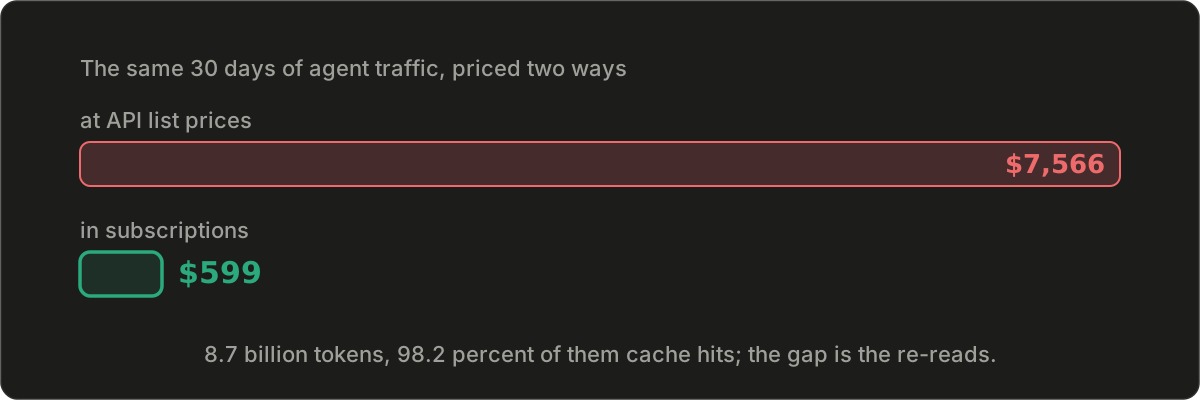
Thirty days of running my agent fleet moved 8,707,530,528 tokens through three vendors' models in 70,227 calls across 2,861 sessions. Priced at each vendor's published API list price, that traffic bills $7,566. The three subscriptions that covered it cost $599. The ratio is nearly thirteen to one. The interesting part is where the tokens went.
The numbers come from a local usage tracker that reads every session transcript on my machine and prices each call at the vendor's list price for that model, so they are a counterfactual, what the same traffic would have cost on the metered API, not an invoice. Two of the ten models in the table are priced from estimated token counts because their CLIs do not report exact ones, and they account for about seven percent of the total. Everything else is exact.
Ninety-five percent of the tokens were re-reads#
The token breakdown is the whole story of why the two meters diverge. Fresh input, the text the models had never seen before, was 154 million tokens. Output, the text they wrote, was 40 million. Cache writes, context stored so the next turn could reuse it, were 222 million. Cache reads were 8.29 billion. Ninety-five percent of the month's volume was a model re-reading context it had already been shown, and the cache hit rate across all of it was 98.2 percent.
That shape is what an agent session looks like from the inside. Every turn the model takes, it re-reads the system prompt, the rules files, the tool results and the whole conversation so far, then writes a few hundred tokens of decision. A product call is the opposite shape: a short prompt, a short answer, nothing carried forward. The largest of these APIs prices cache reads at a tenth of fresh input, which is why I once spent a post on getting the cache prefix right, and even with that discount the re-reads dominate the API-equivalent bill. A flat-rate subscription with a weekly allowance is priced for exactly this shape, which is presumably why the allowance, and not the dollars, is the scarce resource on every plan I pay for.
The supervisor costs more than the typists#
By model, the frontier tier I use for supervision, planning, briefs, diff review and merge decisions, accounted for $3,455 of the $7,566, across 7,954 calls and 2.9 billion tokens. It wrote almost no code. The second vendor's mid-tier model took 23,201 calls and 2.6 billion tokens for $1,468; the mid-tier on the first vendor took 9,075 calls for $1,221. The model that typed the bulk of the last week's merged code, a third vendor's coding model that I dispatch with a written brief, took 9,391 calls and 560 million tokens for $295. The small model that runs the mechanical wrapper scripts made 9,771 calls for $97.
Read as a ratio, the frontier supervisor cost twelve times what the typist cost, for the same month of shipped work. That is the price of the routing rule I wrote in July: the frontier model thinks, cheaper models build, the off-quota model types. The rule moved the typing off the expensive meter, as intended. It did not move the reading, because reading is what supervision is. Every review turn re-reads the session, and the session is where all the context accumulates, so the supervisor's bill scales with session length while the typist's scales with diff size. The typist's diffs were larger. The supervisor's sessions were longer, and length won.
The daily peaks make the same point. The four most expensive days of the month, August 26, August 27, August 31 and September 7, each moved between 860 million and 1.16 billion tokens and would each have billed between $640 and $1,004 on the API. Those were merge waves: dozens of pull requests reviewed and landed in a day, which means dozens of full-session re-reads by the supervisor, not dozens of large diffs. On the subscription those days cost nothing extra. They cost allowance, and an earlier wave in July, when a fan-out of frontier-tier subagents tripped the allowance outright, is how I learned to cap the fan-out.
What the thirteen to one does not mean#
It does not mean the API is overpriced, and it does not mean I would have spent $7,566 without the subscriptions. Nobody runs this shape of workload on a metered API without changing the shape: shorter sessions, aggressive context trimming, fewer review passes. The counterfactual is what this behavior would have cost, and the behavior exists because the flat rate made it free at the margin. The subscription did not save me $6,967. It let me work in a way that would not have occurred to me on a meter.
It also does not mean subscriptions are the answer for everything. The site's backend makes its own model calls when a reader asks the finance tools a question, and those run on the API, metered per call. They are small, independent and infrequent, the opposite shape from an agent session, and the bill is small enough that I have declined to dress it up as a cost story before. The line between the two meters is the line between development and runtime, and I have never had a reason to cross it in either direction.
Route by who pays for the retry#
The rule I run now is one sentence. If a call's cost scales with how much has to be re-read, it goes on a subscription; if it scales with how much has to be answered, it goes on the API. Agent sessions re-read, so they live on three flat-rate plans, and the routing across them exists to protect the weekly allowances, not the dollars. Product calls answer, so they live on the meter, where a short request costs a fraction of a cent and nothing accumulates between requests.
The number I watch is not the $7,566, which is a counterfactual, and not the $599, which is fixed. It is the 98.2 percent. The day that falls is the day the sessions have started re-reading context they cannot reuse, and on a subscription that shows up as an allowance that runs out on Wednesday, not as a bill.
Questions this post answers
- Is a subscription or the API cheaper for AI coding agents?
- For agent work run from a chat session, the subscription, by more than an order of magnitude in my case. The last 30 days of my agent fleet moved 8.7 billion tokens across 70,227 calls. Priced at each vendor's published API list price that is $7,566; three subscriptions at $200, $200 and $199 a month covered all of it for $599. The API is the right meter for a product that answers users, where each call is small and independent. Agent sessions re-read enormous context on every turn and are shaped for a flat-rate plan.
- How many tokens does an AI coding agent fleet use in a month?
- Mine used 8,707,530,528 in 30 days: 154 million fresh input tokens, 40 million output tokens, 222 million cache writes, and 8.29 billion cache reads. Ninety-five percent of the volume was the model re-reading context it had already seen, which is why the cache hit rate of 98.2 percent matters more than any per-token price.
- Why does the supervising model cost more than the models writing the code?
- Because supervision is reading. The frontier model that plans, briefs, reviews diffs and decides merges accounted for $3,455 of the $7,566 API-equivalent while writing almost none of the code; the model that typed the bulk of the last week's merged code accounted for $295. Every review turn re-reads the whole session, and the session is where the context lives.
- What does the API get used for, then?
- The product's own runtime calls: the small, independent requests the site's backend makes when a user asks it something. Those are metered per call and are cheap because each one is short. Agent development work never touches that meter.
Keep reading
Fable Thinks, Opus Builds, Kimi Types
I split a day of development across two AI subscriptions: judgment on the Anthropic meter, typing on Moonshot's. Five merged PRs later, here is where the tokens went, how K3's pricing actually compares, and how I'm tuning the mix.
Prompt caching is a prefix match, not a flag
Prompt caching looks like a flag you flip for a cheaper bill. It is really the reuse of a stored prompt prefix, governed by three rules, and applying it across four parts of my own system showed where it pays, where it quietly does nothing, and where it is not even my decision. With the token counts I measured to check.
How many AI coding agents can you actually run at once?
About ten on one subscription, and the model is never what stops you. Four shared resources under the agents set the ceiling: the link to the vendor and its quota window, the git checkout, the port your tests bind, and the file every branch regenerates. What a seven-agent wave broke, with counts.
When CI Costs More Than It Saves
GitHub Actions' default minute allowance is priced for a team that types at human speed. At agent velocity the bill breaks before the engineering does. Here is how a forced workaround, a local CI mirror plus local deploys, became the better default.
Watch the agent write
A polish agent drafts an essay against a pre-approved topic.
Multi-Region Workflow Orchestration Platform
Own the multi-region orchestration platform: shared execution guarantees, mandatory safety checks, and self-service onboarding for development teams.
Follow the work
New tools and writing as they ship — pick a channel.