Fable Thinks, Opus Builds, Kimi Types
Five merged pull requests across three repos in the first day: a 661-line integration in my finance backend, its infrastructure pair, house-style concept figures back-filled across 29 posts on this blog, and two small arcade games for the lab. Every line of that was typed by Kimi K3 on a Moonshot subscription. My Claude meter spent the day on specs, briefs, and reviews, and a day in, both meters read about a quarter used. Neither is competing with the other for the same allowance, and that is the feature.
This is the fourth post in the model-routing series. In June I said goodbye to Opus, then hello again four days later when an export directive pulled Fable offline and I noticed I had burned 90% of my usage. In July I admitted the tiering plan failed because it lived in my head instead of in files and moved it into an architecture decision record: the frontier model supervises, the workhorse executes, the mechanical items go to the cheapest rung. This week the routing table grew a row that Anthropic does not bill at all.
The arrangement is three sentences. I never talk to Kimi; I talk to Claude, and when an item is scoped tightly enough that the brief removes all judgment, Claude dispatches it. A wrapper runs Kimi's coding agent headless, re-runs the tests itself, and brings back a diff. Nothing merges until a supervisor has read every line.
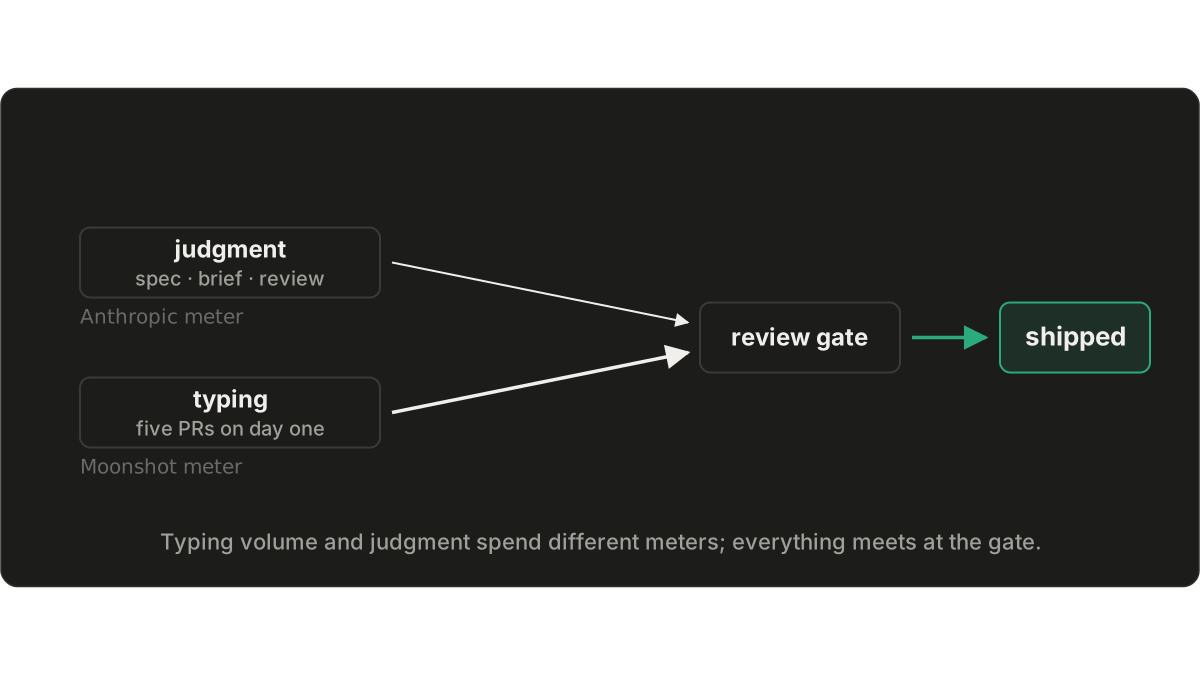
Where the tokens go#
A day of development is lopsided in a way a single meter hides. By volume it is nearly all typing: implementations, tests, doc sweeps, the long tail of items that are obvious once the design is settled. The judgment that steers it, the spec, the brief, the review, is a thin stream by volume and nearly all of the consequence.
The series so far is the story of learning that shape the expensive way. In June everything ran on the frontier model, which burns my cap at roughly twice the workhorse rate, and typing was most of the burn. July's fix routed the typing to a cheaper model on the same meter. This week's fix moves it off the meter entirely: the scarce meter holds the judgment, the abundant meter absorbs the volume, and the exchange works because a verification gate sits where the two streams meet.
Is Kimi actually cheaper?#
By the sticker, sort of. K3's API pricing is $3 per million input tokens and $15 per million output, which is exactly Claude Sonnet's sticker, under Claude Opus at $5 and $25, and well under the frontier tier. So per typed token, yes: routing implementation off Opus-class models onto K3 is a real saving. Moonshot is pricing like a frontier lab, though; their previous flagship cost $0.95 and $4, and the benchmarks say the scores justify it. K3 is a 2.8-trillion-parameter model self-reporting 76.8% on SWE-bench Verified, scored fourth of 189 models on Elo by Artificial Analysis, behind only the current frontier tier.
But the combo does not run on API stickers. It runs on two subscriptions: Kimi's plans ladder from $19 to $199 a month against Claude's roughly comparable ladder, each with its own weekly allowance. At that level the per-token comparison mostly dissolves, and what you are actually buying is a second pool. Before this week, a heavy typing day and a heavy thinking day drew down the same cap and the cap decided which one I got. Now the typing has its own meter, and the judgment meter stretches across a week of work it never has to type.
One caveat carries real weight for the tuning below: K3's reasoning is always on and it thinks hard by default. Simon Willison measured 13,241 reasoning tokens spent producing 3,417 output tokens on a single task. On a weekly allowance with a rolling five-hour window, that is a meaningful tax when the task did not need the thinking.
What a day proved, including the failure#
The five PRs are the delegation working. The infrastructure pair passed its config tests and compile on the first dispatch. The backend integration came back with twelve new tests and the full 3,285-test suite green; my review haul was two unused imports and a formatting miss. The figure backfill and the games ran overnight as supervised waves. And the gates earned their keep in the other direction too: one experiment, routing my finance engine's grounded research through K3, failed live verification the same morning it shipped (the endpoint's web search quietly returns empty results) and was rolled back within the hour behind an environment flip the spec had demanded in advance. A scan of the stored research rows confirmed zero bad data landed. The coding tier never noticed.
Tuning the mix#
The question after day one is not whether to delegate but whether I delegate enough, and the answer is not yet. The typing that moved was the typing I had briefs for. The next turn of the dial routes the standing mechanical backlog, the doc syncs and config flips and test sweeps that currently burn the cheapest Anthropic rung, down to the Kimi tier by default.
The model mix inside that tier is also a dial. K3 is the flagship, but a quarter of the weekly allowance in one day says the flagship is the wrong daily driver for judgment-free work: its always-on reasoning is priced for exactly the judgment my briefs are designed to remove. So the worker tier now defaults to Moonshot's coding-tuned K2.7 model, with K3 one flag away for the big multi-file diffs that reward a deeper typist. Same shape as the Claude side of the table, one rung down: match the model to the task, and put the restraint in config.
Fable thinks, Opus builds, Kimi types. Four posts in, the slogan finally describes a system rather than an intention.